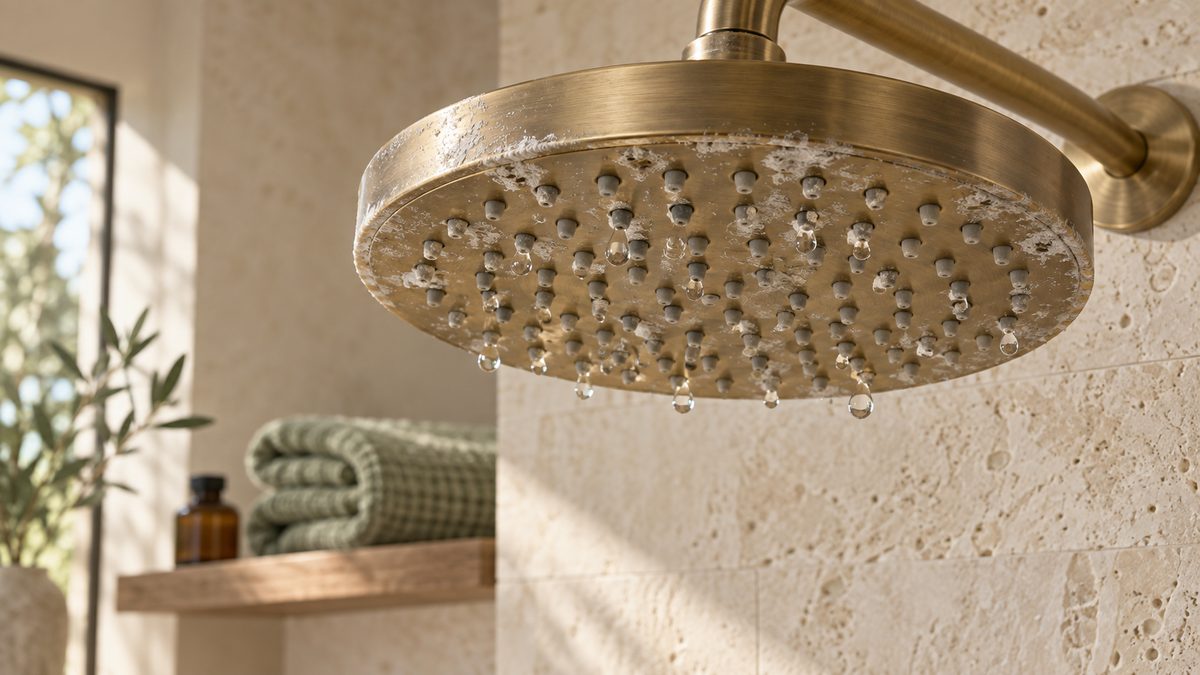
Look up at your shower head. If the nozzles carry a chalky white crust, you are looking at the same minerals that meet your skin every morning. In North Texas, almost everyone has that crust, and almost everyone has a theory about what it is doing to their face.
Some of those theories are right and some are sold to you. This guide sorts them: how hard the water around Dallas actually is, what calcium and magnesium do when they meet your cleanser, what the research says about eczema and hair, and which of the filters and softeners on the market change anything. It is written from a treatment room on Trinity Mills Road, where the water is the same as yours.
How hard is the water around Dallas?
Hardness is the amount of dissolved calcium and magnesium in water, reported as milligrams of calcium carbonate per liter. The U.S. Geological Survey sorts it into four bands: soft up to 60 mg/L, moderately hard from 61 to 120, hard from 121 to 180, and very hard above 180.
The surprising part is that Dallas Water Utilities does not publish a hardness figure. Its 2025 annual water quality report covers contaminants and disinfectant levels but not hardness, and the same is true of the reports for Addison and Carrollton, which buy their water from Dallas. The numbers you see online for Dallas come from water-softener sellers and disagree with each other, so we are not going to repeat one.
The cities around us do publish theirs, and they are a fair guide to what the region is working with:
| Area | Water supplier | Total hardness (2025 reports) |
|---|---|---|
| Plano, Frisco and other NTMWD cities | North Texas Municipal Water District | 96 to 200 mg/L across its plants |
| Fort Worth | Fort Worth Water | 108 to 150 mg/L |
| Dallas, Addison, Carrollton | Dallas Water Utilities | Not published in the annual report |
Two details are worth knowing. These are ranges, not averages: hardness shifts with the source lake and the season, so the same tap can sit in different bands across the year. And the utilities describe the same water more gently than the USGS scale would. The North Texas Municipal Water District calls its supply "moderately hard", mostly because of the minerals in Lavon Lake, while readings at the top of its range are "very hard" by the federal definition. Either way, by the time it reaches your shower it carries enough calcium to leave that crust on the nozzles.
The water is also disinfected with chloramine, a combination of chlorine and ammonia that lasts longer in the pipes than chlorine alone. Both the North Texas Municipal Water District and Dallas use it. That matters later, because chloramine is what most shower filters are actually built to deal with.
What calcium and magnesium actually do to skin
On their own, the minerals are harmless. Calcium and magnesium are not toxic, and nobody's skin is damaged by standing in hard water. The problem starts when they meet soap.
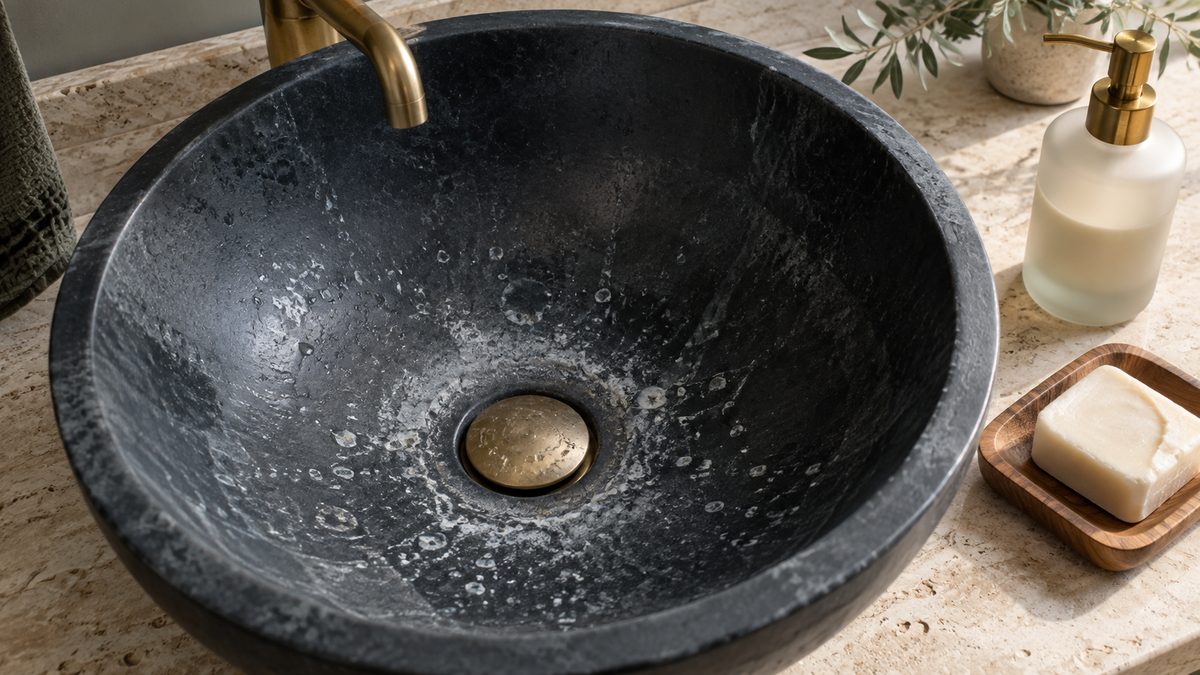
Traditional soap and many foaming cleansers rely on surfactants such as sodium lauryl sulfate (SLS) and sodium laureth sulfate. Calcium and magnesium bind to those molecules and make them insoluble, so instead of rinsing away they settle. You can see the same reaction on a dark basin: the cloudy film around the drain is soap that has met hard water and stayed behind.
In 2018, a team from the universities of Sheffield and London measured this on skin. Volunteers had small patches of skin washed with SLS in hard water and in softened water. The hard-water sites held significantly more SLS afterwards, and that residue caused more irritation, most of all in people with eczema who carry a common mutation in the gene for filaggrin, a protein the skin barrier depends on. Removing the calcium and magnesium with an ion-exchange softener reduced the effect.
There is a pH side to this too. Healthy skin keeps a slightly acidic surface; one study put the natural average at about 4.7. Tap water is closer to 8, and the same study found that rinsing with ordinary tap water raised skin pH for up to six hours afterwards. In the 2018 study, the surfactant residue left behind also pushed skin pH up. A less acidic surface is a less effective barrier, which is one reason the tight, dry feeling after a long hot shower is so common here.
What hard water does not do is cause acne by itself. There is no good evidence that the minerals clog pores. If you break out in Dallas, heat, sweat and sunscreen are far more likely culprits; our Dallas summer skincare guide covers those in detail.
Hard water and eczema: what the research shows
This is where hard water has the most research behind it, and also where it is most often overstated.
The association is real
A 1998 study of primary-school children in Nottinghamshire, England found eczema in 17.3% of children in the hardest-water areas against 12.0% in the softest. A 2016 study of more than 1,300 three-month-old babies in England and Wales found a higher risk of eczema in homes with hard water. Both are observational: they show that eczema and hard water tend to occur together, not that one causes the other.
Softeners have not been shown to treat it
The strongest test so far is the SWET trial, published in 2011. Researchers installed ion-exchange softeners in the homes of 336 children with moderate to severe eczema and compared them with children who carried on with usual care. After twelve weeks, the softeners provided no additional benefit.
A newer pilot, the SOFTER trial, asked a different question: could softening the water before a baby is born prevent eczema in families with a history of allergy? At six months, 33% of babies in softened homes had visible eczema against 48% in the comparison group. That is encouraging, but it was a small pilot designed to test whether a full trial was possible, and the authors ran no significance test. It is a reason to run a bigger study, not a reason to buy a softener.
The practical takeaway for adults with eczema-prone or very reactive skin is narrower than the marketing suggests: the combination to avoid is hard water plus harsh foaming detergent. You can change the detergent today.
Hair and scalp
Hair is where most people first notice the water. The evidence on actual damage is mixed. A 2018 study found that hair washed in hard water had lower tensile strength than hair washed in deionized water, and the authors concluded that hard water increases breakage. A 2016 study found more calcium on hard-water-washed strands and a slightly thinner, ruffled-looking surface. But a 2013 study found that hard water made no difference to tensile strength or elasticity. All three were small lab studies on cut hair, so none of them settles it.
What is not in dispute is residue. Mineral film and the same insoluble soap scum that forms on skin build up on the hair shaft and scalp, which is why hair can feel coated or look dull, and why a scalp can itch or flake even when it is washed often. It is the reason scalp work in North Texas tends to start with a thorough cleanse rather than going straight to massage.
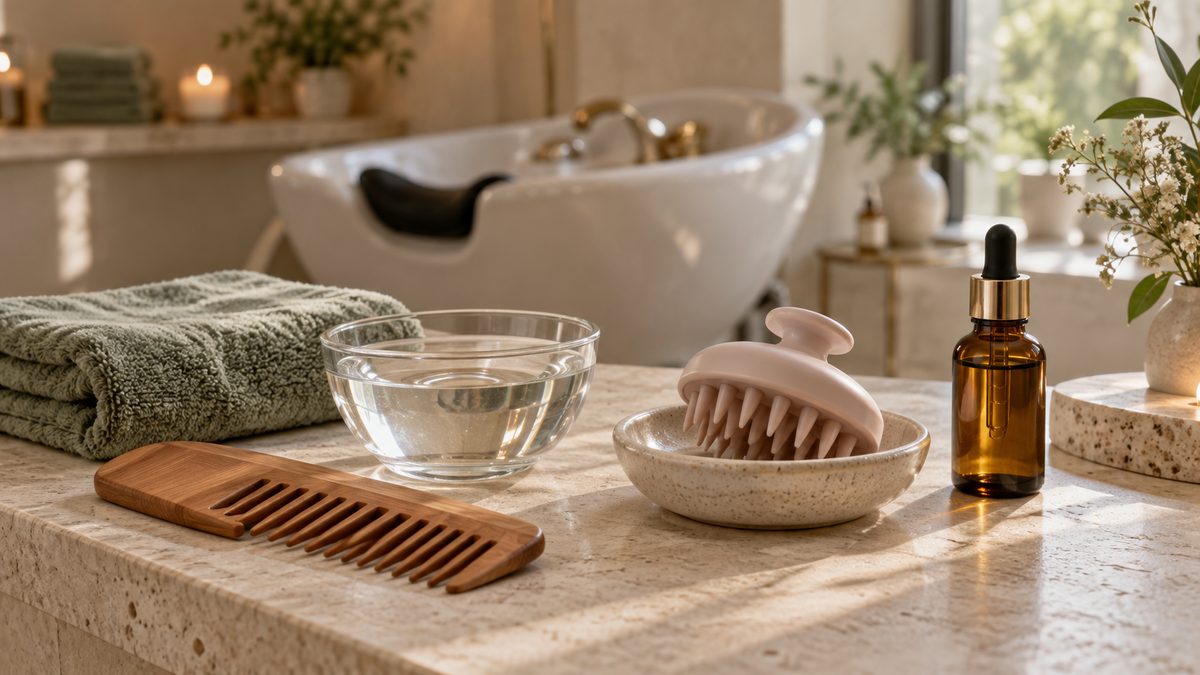
For hair and scalp, the steps that help are simple:
- A clarifying or chelating shampoo every week or two to lift mineral and product build-up. There is little controlled research on these, but they are designed for exactly this residue; use them sparingly, as they can be drying.
- Conditioner every wash, concentrated on the lengths, to smooth a cuticle roughened by deposits.
- Massage the scalp while you cleanse rather than just pouring shampoo over it, so the residue at the roots actually lifts.
Shower filters vs. softeners: what each one removes
This is the section that will save you money. Most products sold as hard-water fixes for the shower do not remove hard-water minerals.
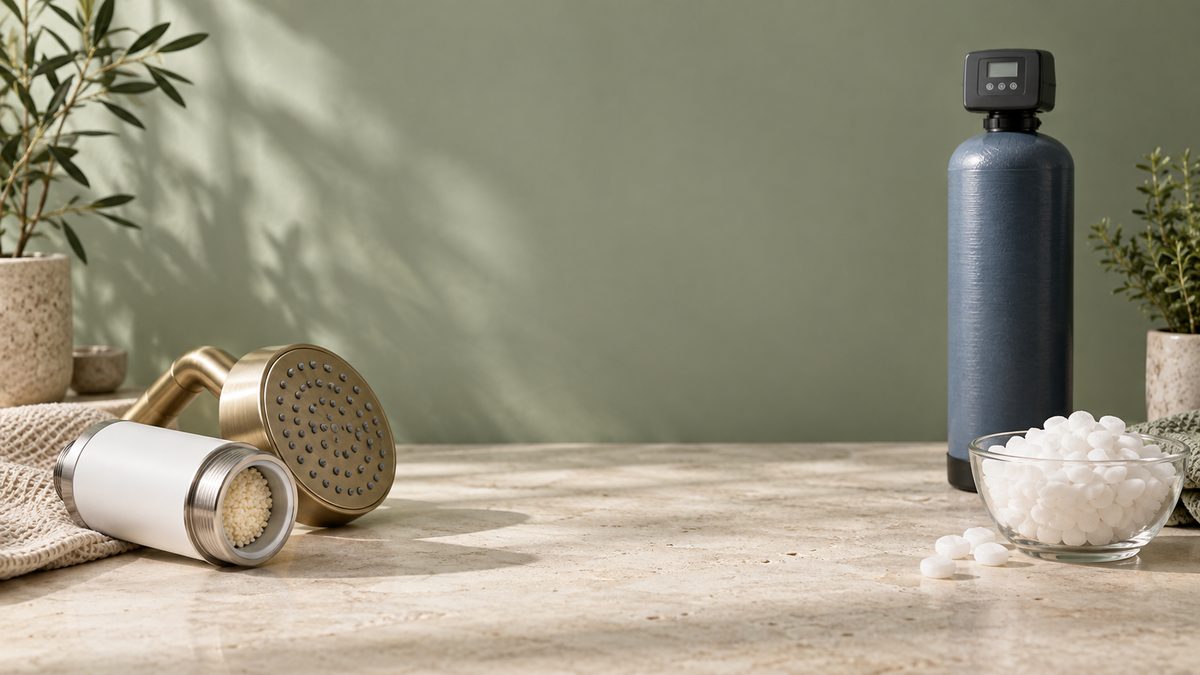
| Device | What it reduces | What it leaves |
|---|---|---|
| Carbon shower filter | Chlorine; chloramine and some disinfection by-products, depending on the carbon type | Calcium and magnesium: the water stays just as hard |
| Vitamin C cartridge | Neutralizes chlorine | Calcium and magnesium |
| Ion-exchange water softener (whole house) | Calcium and magnesium, swapped for sodium or potassium | Chlorine and chloramine, unless paired with a filter |
A shower filter is still a reasonable buy if chlorine bothers you, but go in knowing what it does. Plain activated carbon handles chlorine well and chloramine less reliably; filters meant for chloramine usually say they use catalytic carbon. "Softening" shower heads that contain only filter media are not softeners.
A whole-house softener is the only option here that actually removes the minerals. It is also a real expense, needs salt and maintenance, and, as the SWET trial showed, has not been shown to improve eczema that is already there. For most households it is a plumbing and appliance decision first and a skincare decision second.
A hard-water routine that works all year
None of this needs new equipment. These are the changes that address what the research actually found:
- Change the cleanser before you change the water. Swap traditional bar soap and high-foam SLS cleansers for a gentle, low-foam or cream cleanser. Less surfactant means less of it for the minerals to bind to.
- Keep showers warm, not hot, and short. The American Academy of Dermatology suggests five to ten minutes with warm water. Heat and time both increase how much the barrier loses.
- Moisturize straight after drying. Pat skin dry and apply a fragrance-free moisturizer immediately, while the skin is still slightly damp. This is the single most useful habit for anyone whose skin feels tight after a shower.
- Rinse thoroughly. In hard water, residue is the problem, so the rinse deserves as much attention as the lather, especially along the hairline and jaw where cleanser collects.
- Clarify the scalp, gently, on a schedule. Every week or two, not every wash.
- If your skin is eczema-prone, be strict about 1 to 3. That is the group the research found most affected, and the group that benefits most from fewer surfactants and less time in the water.
Hard water is a constant here, not a seasonal problem, but it adds up with everything else the climate does. In summer it stacks on top of heat and sweat; in winter, on top of indoor heating. For how often a professional treatment fits around that, see our guide on how often you should get a facial.
Frequently asked questions
Yes, though Dallas itself does not print a hardness number in its annual water report. Its neighbours do: the 2025 reports from Plano and Frisco, which buy treated water from the North Texas Municipal Water District, list total hardness of 96 to 200 mg/L, and Fort Worth lists 108 to 150 mg/L. On the USGS scale, anything above 120 mg/L counts as hard.
It has not been shown to cause it. Studies in the UK found eczema more common in children living in hard-water areas, and a 2018 lab study found hard water leaves more detergent on skin, which irritated people with eczema most. But a 2011 trial found that installing a water softener did not improve existing eczema in children.
No. Carbon shower filters are designed to reduce chlorine and chloramine, and vitamin C cartridges neutralize chlorine. Neither removes calcium or magnesium, which is what makes water hard. Softening needs an ion-exchange softener, usually installed for the whole house.
For most people with healthy skin, the honest answer is that the evidence does not justify buying one for skin alone. It is more persuasive if you have eczema-prone or very reactive skin and your cleansers are foaming detergents, because that is the combination the research found most irritating. Changing the cleanser costs far less and is worth trying first.
The research is mixed. Small lab studies have found more mineral deposits and lower tensile strength in hair washed with hard water, while another found no difference in strength or elasticity. What most people notice day to day is residue: hair that feels coated or dull and a scalp that never feels quite clean.
Usually a combination of water that is too hot, a shower that runs long, and a foaming cleanser. In hard water, soap and some detergents leave more residue behind, and tap water itself is more alkaline than your skin's natural surface. Shorter, warm rather than hot showers and moisturizer applied straight after drying help most.
Sources & further reading
Water-quality reports and research consulted for this article, checked in October 2026. This post is general education and is not a substitute for personalized guidance from a licensed esthetician or board-certified dermatologist.
- U.S. Geological Survey. Hardness of Water — soft 0–60, moderately hard 61–120, hard 121–180, very hard above 180 mg/L as calcium carbonate.
- City of Dallas. Water Quality Reports — the 2025 report lists disinfectant and contaminant levels; it does not report hardness.
- City of Frisco. 2025 Annual Water Quality Report — NTMWD total hardness as CaCO3 of 96–200 ppm; describes the supply as "moderately hard"; chloramine disinfection.
- City of Plano. 2025 Water Quality Report — the same NTMWD hardness range; notes NTMWD uses chloramines for disinfection.
- North Texas Municipal Water District. Protecting Our Drinking Water — treated water is "moderately hard" primarily because of minerals in Lavon Lake.
- City of Fort Worth. Water Quality — total hardness as CaCO3 of 108–150 ppm (6–9 grains per gallon).
- Dallas Water Utilities. Water Quality Customer Fact Sheet (2019) — describes Dallas's chloramine disinfection and notes treatment retains the hardness minerals.
- Danby SG, Brown K, Wigley AM, et al. The Effect of Water Hardness on Surfactant Deposition after Washing and Subsequent Skin Irritation in Atopic Dermatitis Patients and Healthy Control Subjects — J Invest Dermatol, 2018 (PMID 28927888) — hard water increased SLS deposits and irritation, most in eczema patients with filaggrin mutations; ion-exchange softening mitigated it.
- Lambers H, Piessens S, Bloem A, Pronk H, Finkel P. Natural skin surface pH is on average below 5, which is beneficial for its resident flora — Int J Cosmet Sci, 2006 (PMID 18489300) — natural skin pH averages about 4.7; tap water raises it for up to six hours.
- McNally NJ, Williams HC, Phillips DR, et al. Atopic eczema and domestic water hardness — Lancet, 1998 (PMID 9716057) — 17.3% prevalence in the hardest-water areas vs 12.0% in the softest.
- Perkin MR, Craven J, Logan K, et al. Association between domestic water hardness, chlorine, and atopic dermatitis risk in early life — J Allergy Clin Immunol, 2016 (PMID 27241890) — higher eczema risk in 3-month-old infants in hard-water homes.
- Thomas KS, Dean T, O'Leary C, et al. A randomised controlled trial of ion-exchange water softeners for the treatment of eczema in children (SWET) — PLoS Med, 2011 — softeners provided no additional benefit to usual care in 336 children.
- Jabbar-Lopez ZK, Ezzamouri B, Briley A, et al. Randomized controlled pilot trial with ion-exchange water softeners to prevent eczema (SOFTER trial) — Clin Exp Allergy, 2022 (PMID 34854157) — 33% vs 48% visible eczema at six months; a feasibility pilot with no significance testing.
- Luqman MW, Ramzan MH, Javaid U, et al. To Evaluate and Compare Changes in Baseline Strength of Hairs after Treating them with Deionized Water and Hard Water and its Role in Hair Breakage — Int J Trichology, 2018 — lower tensile strength in hair washed with hard water.
- Srinivasan G, Chakravarthy Rangachari S. Scanning electron microscopy of hair treated in hard water — Int J Dermatol, 2016 (PMID 26711619) — higher calcium deposition and a ruffled, thinner shaft.
- Srinivasan G, Srinivas CR, Mathew AC, Duraiswami D. Effects of hard water on hair — Int J Trichology, 2013 — no difference in tensile strength or elasticity.
- University of Nebraska–Lincoln Extension. Drinking Water Treatment: Activated Carbon Filtration (G1489) — carbon can reduce chlorine and chloramines but does not remove calcium and magnesium.
- USDA Forest Service. Using Vitamin C to Neutralize Chlorine in Water Systems — ascorbic acid and sodium ascorbate neutralize chlorine.
- American Academy of Dermatology. Dermatologists' top tips for relieving dry skin — five-to-ten-minute warm showers, then moisturizer immediately after patting dry.