It is 11:14 PM. The lamps are off but your nervous system did not get the memo — you are scrolling, jaw tight, brain replaying the day at double speed. The cliché "go to bed earlier" is not a plan when your body is still in fight-or-flight. What you need is a signal — something predictable enough to tell the brainstem that the day is over.
Sound therapy is one of the better-studied non-pharmaceutical signals for exactly this. It is not a crystals-and-chimes mystery; it is reviewed by the Cochrane Collaboration, studied at Northwestern's sleep lab, and consistently associated with measurable shifts in heart-rate variability, cortisol, and sleep quality. This guide walks through the five sound-based practices with the strongest evidence behind them, the science of why singing bowls have become a fixture in modern spa rooms, and a simple ten-minute home routine you can try tonight.
Why sound therapy works
Your autonomic nervous system runs in two modes: sympathetic (fight-or-flight) and parasympathetic (rest-and-digest). Slow, predictable audio signals "safe" to the brainstem and shifts the body toward the second mode. Two physiological markers researchers track are heart-rate variability, where higher is better, and cortisol, where lower is better. Music and nature sounds reliably move both.
A 2022 meta-analysis of 47 music-therapy studies covering 2,747 participants found a medium-to-large effect on stress-related outcomes — covering HRV, cortisol, blood pressure, and self-reported anxiety — with an effect size of d = 0.72. That is a stronger result than most alternative-medicine interventions ever produce in pooled analyses.
Sleep is a separate mechanism. Certain audio patterns can deepen slow-wave sleep by syncing with the brain's own oscillations during the deepest stages of rest. Northwestern researchers demonstrated this in older adults: precisely timed pink-noise pulses, locked to the up-state of the brain's slow oscillations, increased slow-wave activity and tripled overnight word recall compared to a sham control.
The thread connecting all five tools below is the same: each one delivers slow, predictable, low-arousal audio in a form the nervous system reads as safe.
Five evidence-backed ways sound helps stress and sleep
1. Singing-bowl sound baths
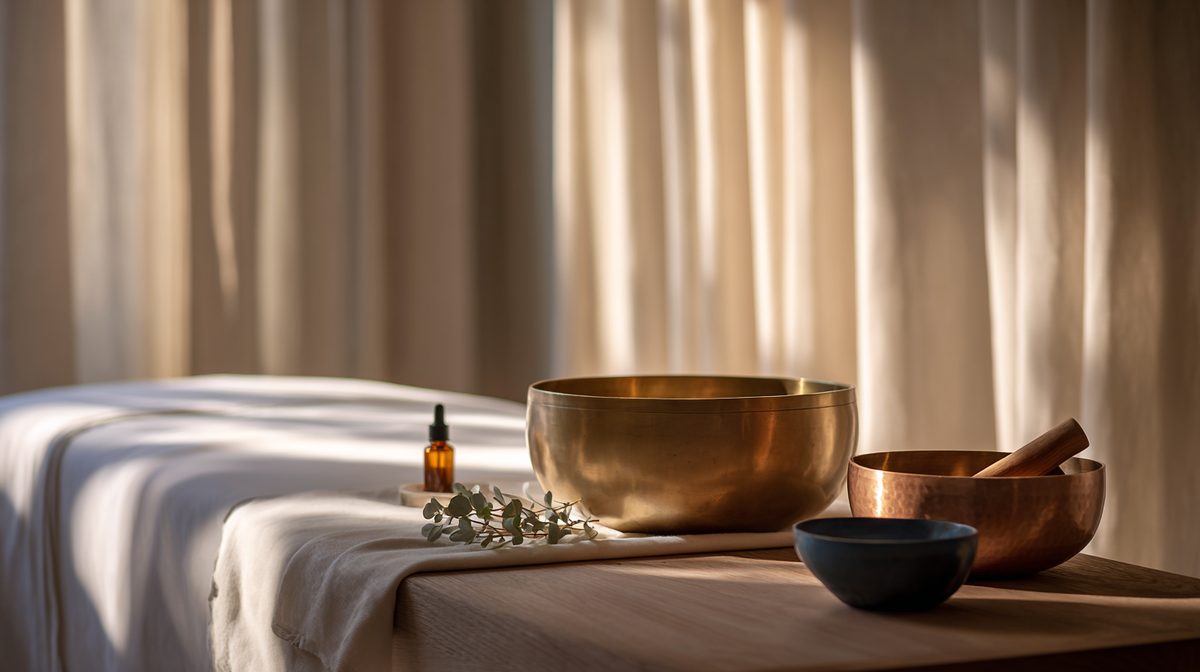
A sound bath is a 30- to 60-minute session in which a practitioner plays low-frequency Himalayan (brass and copper alloy) or crystal singing bowls while participants lie down. The resonance is felt as much as heard — low frequencies travel through the body, not just the ears. Bowl traditions vary (Tibetan, Nepalese, modern quartz), but the underlying physiological mechanism is the same: slow, predictable, low-arousal vibration that the nervous system reads as deeply safe.
In the most-cited study on the practice, Goldsby and colleagues observed 62 adults before and after a single 60-minute Tibetan singing-bowl meditation. Participants reported significantly less tension, anger, fatigue, and depressed mood (all p < 0.001), and increased spiritual well-being. The largest drops in tension came from first-timers — people new to the practice benefited more than experienced meditators. A 2025 systematic review in Healthcare pulled together multiple controlled trials and confirmed consistent reductions in anxiety, depressed mood, and blood pressure.
Why bowls and not just a recording: bowls add vibration as well as sound. Low-frequency tones — typically 100 to 300 Hz with rich harmonics — travel as mechanical energy through tissue and bone, not just air. The clinical literature on this exact mechanism is still developing, but the client experience ("deeper than a recording") aligns with what the physics predicts.
Honest caveat: most singing-bowl studies are small and many lack active control groups, so the effect is real but the magnitude is not perfectly nailed down. Treat bowls as a high-quality relaxation modality with strong directional evidence — not as a treatment for any diagnosed condition.
2. Slow music before bed
The single best-studied sleep intervention in this entire category is also the simplest: 30 to 45 minutes of slow-tempo (roughly 60–80 bpm), instrumental, self-selected music at bedtime.
The 2022 Cochrane review on this question — 13 randomized controlled trials covering 1,007 adults with insomnia — found moderate-certainty evidence that bedtime music improves subjective sleep quality on the Pittsburgh Sleep Quality Index, with a mean difference of −2.79 (about one standard deviation of improvement). It also showed low-certainty evidence for shorter sleep onset and better sleep efficiency. Across all included studies, there were zero adverse events.
Practical version: pick a calm, instrumental playlist you actually like (familiarity matters; a track you find soothing beats an algorithmically "correct" one). Start it ten minutes before lights-out. Keep volume low. Give it two to three weeks of nightly use before judging the result.
3. Pink noise during deep sleep
Pink noise is what you get when you take white noise (energy flat across all frequencies) and tilt its energy toward the lower end — think a steady waterfall, or rain on a metal roof. It is the most-studied sleep-enhancing noise color.
The Papalambros 2017 study used a real-time algorithm to deliver tiny pulses of pink noise, perfectly synced to the upward sweeps of slow oscillations in 13 older adults during deep sleep. Slow-wave activity rose, and overnight word-recall improvements were roughly three times larger on the stimulation nights than on sham nights. Subsequent research has replicated the basic effect in adults with mild cognitive impairment.
One important caveat that newer research has surfaced: a 2023 study found that continuous overnight pink noise can actually interfere with certain forms of sleep-dependent memory consolidation. The cleaner pattern, based on current evidence, is to use pink noise for the first 20–30 minutes after lights-out — to help with sleep onset — and let the room go quiet once you are asleep. Many sleep-noise apps now include a fade-out timer for exactly this reason.
4. Binaural beats for anxiety
Binaural beats are an audio trick: play one frequency in the left ear (say 200 Hz) and a slightly different one in the right (say 210 Hz), and the brain perceives a third "beat" tone at the difference frequency (10 Hz). The theory is that the brain entrains to the perceived beat, sliding the dominant brainwave toward a calmer state.
A 2019 meta-analysis by Garcia-Argibay and colleagues pulled together 22 studies and 35 effect sizes. The overall effect on cognition, anxiety, and pain was medium and statistically significant (g = 0.45). For anxiety specifically, theta- and delta-range binaural beats produced a medium-to-large effect (g = 0.69) across five effect sizes. Longer exposure (more than 20 minutes) and listening before a stressful task — rather than only during it — produced larger benefits.
Practical: you need stereo headphones; the effect collapses over speakers because both ears hear both frequencies. Free apps and YouTube tracks abound; you do not need a paid subscription. Treat it as a 20- to 30-minute pre-meeting or pre-bed wind-down, not as all-day background.
5. Nature sounds for daytime stress recovery
The most studied non-music soundscapes are natural ones: rainfall, forest, ocean, stream. The 2017 Gould van Praag study published in Scientific Reports measured both brain connectivity and heart-rate variability while participants listened to naturalistic versus artificial sounds. Natural sounds increased peak high-frequency HRV — the marker of parasympathetic activation — and shifted brain connectivity toward an outward-directed, less ruminative pattern. Participants who started the experiment most stressed showed the largest benefit.
A 2024 systematic review and meta-analysis in the journal Stress compiled multiple controlled trials and confirmed that natural-sound exposure reliably reduces self-reported stress and improves physiological recovery compared to urban-noise and silent controls.

Practical version: a 10- to 15-minute mid-afternoon listening session with a natural soundscape only — no music, no podcasts, no narration. Eyes closed if you can. This is the lowest-friction entry point in the entire list; it costs nothing and works on speakers as well as headphones.
Why singing bowls show up in skincare
Walk into a modern spa and you are increasingly likely to hear a singing bowl tone overlap with the click of a steamer or the rustle of fresh linen. This is not aesthetic theater. The same physiology that drops tension during a 60-minute sound bath drops it during a 60-minute facial. Skincare appointments are not surgery, but they sit on the same continuum: a person lying still under another person's hands, mildly vulnerable, often anxious about a needle or a peel, often holding tension in the face and shoulders.
The two headline studies on sound paired with a clinical procedure are striking:
- Hole et al. 2015 (The Lancet). A meta-analysis of 73 randomized trials found that music delivered before, during, or after surgery significantly reduced postoperative pain (SMD −0.77), anxiety (−0.68), and post-procedure analgesic use (−0.37). Patient satisfaction rose meaningfully. The effect held even when patients were under general anesthesia.
- Bradt, Dileo, & Shim 2013 (Cochrane). A review of 26 trials covering 2,051 patients concluded that music interventions reduce preoperative anxiety. One included trial found music outperformed midazolam — a benzodiazepine sedative — for calming patients before surgery.
Aesthetic treatments operate on the same nervous system the surgical literature studies. The body does not have one cortisol response for "facial" and another for "minor outpatient procedure" — it has one nervous system that is either braced or it is not. Sound, including bowl tones with their low-frequency vibrational component, is one of the most direct levers spas have to move a client from braced to settled.
Honest scope note: a published randomized trial of "singing bowls during facials" does not yet exist. The case here combines (a) strong evidence for bowls in standalone meditation contexts and (b) strong evidence for music and sound during clinical procedures. The direction of the evidence supports the practice; the precise effect size for this specific combination is still being studied.
A 10-minute home practice
You do not need a practitioner, a studio, or a $500 gong to start. Here is a no-cost, ten-minute starter routine that uses three of the five tools above:
- Minutes 0–2: Lower the lights. Put your phone face-down on Do Not Disturb. Sit upright in a chair or lie down comfortably.
- Minutes 2–7: Play a slow instrumental track (~60–80 bpm) or a natural rainfall recording — whichever you prefer. Eyes closed if you can. Resist the urge to multitask.
- Minutes 7–10: Stop the audio. Sit silently. Notice whether your jaw, shoulders, and breath rate have shifted. They usually have.
Tools that earn their cost: a single pair of over-ear headphones (for binaural beats and music sessions where stereo separation matters) and a free white-noise or natural-soundscape app. That is it. Skip the expensive sound-bath gong unless you genuinely want one — most of the evidence above comes from sessions that cost nothing beyond a phone and a pair of headphones.
Sleep is also one of the largest variables that determine how your skin responds to professional treatment — see our companion guide on how often you should get a facial for the cadence side of that picture.
How we use sound at Healing Lotus
Every treatment at Healing Lotus Spa in Dallas integrates therapeutic sound into the skincare itself — low-frequency singing bowls, ambient tones, rhythmic breathing guidance, and steady healing sound waves. The bowls are not a separate add-on; they accompany the facial or body treatment from the first breath onward.
The reasoning is the one this guide has spent the last two thousand words building. Skin responds to the nervous system underneath it. A client whose breath is shallow, jaw is clenched, and shoulders are raised — that client's skin absorbs serums less efficiently, holds redness longer, and reads the same products differently than a client whose body has dropped into rest. Sound is one of the most direct, least invasive routes to that drop.
As the bowl tones move through the treatment room, four things tend to follow:
- The mind quiets.
- Breathing deepens.
- Tension softens.
- Skin absorption enhances.
Clients new to sound-paired skincare often describe the first half of the session as "where I usually decompress" and the second half as "where I'd usually have been thinking about my email." That is anecdote, not randomized data — but it lines up with what the surgical-music meta-analyses predict for any procedure that asks a person to lie still and trust someone else's hands.
For readers outside Dallas: the home-practice section above stands on its own. If you can find a practitioner who pairs sound bowls with bodywork or facials in your city, the evidence in this guide supports the combination.
Who should be cautious
Sound therapy is overwhelmingly low-risk; the Cochrane music-for-insomnia review found zero adverse events across more than a thousand participants. A few situations still warrant caution:
- Hyperacusis or recruitment-related hearing conditions — gong and bowl sessions can be uncomfortable. Lower the volume or skip.
- Severe vertigo (Meniere's disease, vestibular migraine) — low-frequency vibration may trigger episodes. Ask your ENT before trying a sound bath.
- Cochlear implants — most sound-therapy formats are fine, but binaural beats specifically may not produce the intended effect because of how cochlear-implant signal processing routes audio.
- Active seizure disorder — certain rhythmic stimulation patterns can be a trigger. Check with your neurologist before adding new audio interventions.
- Pregnancy — generally safe; avoid placing low-frequency speakers directly against the abdomen.
This post is general education, not medical advice. If you are treating a clinical condition, talk to your physician before changing your routine.
Frequently asked questions
Meta-analyses show medium-to-large effects on physiological stress markers — heart-rate variability, cortisol, blood pressure — that exceed silent and placebo controls. The 2022 Cochrane review on music for insomnia in adults found moderate-certainty evidence for improved sleep quality on the Pittsburgh Sleep Quality Index, with no adverse events reported across more than a thousand participants.
A single 60-minute singing-bowl session produced measurable mood shifts in the Goldsby 2017 study. Binaural beats tend to show effects with about 20 minutes of exposure before a task. Bedtime music for chronic insomnia typically takes two to three weeks of nightly use to show a meaningful change in sleep quality.
Sound is woven into the treatment from the first breath rather than offered as an add-on — low-frequency singing bowls, ambient tones, and rhythmic breathing guidance run throughout the session. The intent is the same physiology this guide describes: drop the nervous system into rest, then let the skincare work on a body that is no longer braced. Clients new to sound-paired skincare often describe the difference as more visceral than they expect.
Yes, for most people. Use moderate headphone volume to protect your hearing, and stop if you experience headaches or dizziness — both are uncommon but reported in the research. Binaural beats require stereo headphones; they do not work over speakers.
White noise is flat across frequencies and often sounds harsh. Pink noise weights energy toward lower frequencies and sounds like steady rain or a waterfall. Brown noise weights even lower and resembles distant ocean or wind. Pink noise has the strongest direct evidence for deep-sleep enhancement; brown is many people's subjective preference for falling asleep.
No. Sound therapy is a complement, not a substitute. The evidence supports it as an addition to good sleep hygiene and clinical care — not as a replacement for a treatment plan you have already started. Talk to your prescriber before changing any medication.
Anyone with hyperacusis, severe vestibular conditions such as Meniere's disease or vestibular migraine, or an active seizure disorder should consult a specialist before starting. Cochlear-implant users can listen safely to most formats, but binaural beats specifically may not work as intended because of how the implant processes audio.
Sources & further reading
Peer-reviewed studies and systematic reviews consulted for this article. This post is general education and is not a substitute for personalized guidance from a licensed clinician.
- Goldsby TL, Goldsby ME, McWalters M, Mills PJ. Effects of Singing Bowl Sound Meditation on Mood, Tension, and Well-being: An Observational Study. J Evid Based Complementary Altern Med. 2017;22(3):401–406. PubMed 27694559 — 62 participants; a single 60-minute session significantly reduced tension, anger, fatigue, and depressed mood (all p < 0.001).
- Effects of Tibetan Singing Bowl Intervention on Psychological and Physiological Health in Adults: A Systematic Review. Healthcare (MDPI). 2025;13(16):2002. Systematic review — consistent reductions in anxiety, depressed mood, and blood pressure across included trials.
- Jespersen KV, Pando-Naude V, Koenig J, Jennum P, Vuust P. Listening to music for insomnia in adults. Cochrane Database of Systematic Reviews. 2022, Issue 8. PubMed 36000763 — 13 RCTs, 1,007 adults; moderate-certainty evidence for improved subjective sleep quality (PSQI mean difference −2.79).
- de Witte M, da Silva Pinho A, Stams GJ, Moonen X, Bos AER, van Hooren S. Music therapy for stress reduction: a systematic review and meta-analysis. Health Psychology Review. 2022;16(1):134–159. Taylor & Francis Online — 47 studies, 2,747 participants; medium-to-large effect on stress-related outcomes (d = 0.723).
- Hole J, Hirsch M, Ball E, Meads C. Music as an aid for postoperative recovery in adults: a systematic review and meta-analysis. The Lancet. 2015;386(10004):1659–1671. PubMed 26277246 — 73 RCTs; music reduced postoperative pain (SMD −0.77), anxiety (−0.68), and analgesic use (−0.37); effects held under general anesthesia.
- Bradt J, Dileo C, Shim M. Music interventions for preoperative anxiety. Cochrane Database of Systematic Reviews. 2013, Issue 6, CD006908. PubMed 23740695 — 26 trials, 2,051 participants; music reduced preoperative anxiety; one included trial found music outperformed midazolam.
- Papalambros NA, Santostasi G, Malkani RG, et al. Acoustic Enhancement of Sleep Slow Oscillations and Concomitant Memory Improvement in Older Adults. Frontiers in Human Neuroscience. 2017;11:109. PubMed 28337134 — 13 adults age 60–84; phase-locked pink-noise pulses enhanced slow-wave activity and roughly tripled overnight word recall.
- Northwestern News press release summarizing the study. Sound waves enhance deep sleep and memory.
- Garcia-Argibay M, Santed MA, Reales JM. Efficacy of binaural auditory beats in cognition, anxiety, and pain perception: a meta-analysis. Psychological Research. 2019;83(2):357–372. PubMed 30073406 — 22 studies, 35 effect sizes; overall g = 0.45; anxiety-specific theta/delta g = 0.69.
- Gould van Praag CD, Garfinkel SN, Sparasci O, et al. Mind-wandering and alterations to default mode network connectivity when listening to naturalistic versus artificial sounds. Scientific Reports. 2017;7:45273. Nature.com — increased peak high-frequency HRV under natural sound; greatest benefit in the most-stressed participants.
- Sleep Foundation. Pink Noise: Can It Help You Sleep? — consumer-facing explainer on noise colors.
- Certification Board for Music Therapists. cbmt.org — credential lookup for board-certified music therapists (MT-BC).